
How Many Words Should H2 Headings Be in Your Content?
Headings constitute one of the most consequential parts of content structuring. They assist readers in grasping the flow of information pouring into their minds, and also steer the search engines in knowing what your content is about. But then, many writers rarely have any clue about how many words an H2 heading should consist of, or even about the proper use of headings in SEO.
This guide shall discuss the meaning of H1 and H2 headings, their expected role in SEO, worthy H2 heading writing, and the actual number of H2 headings that one can use on a page.
What Are H1 and H2 Headings?
H1 and H2 headings organize your page so readers and search engines can easily grasp what the subject matter of your content is. They introduce hierarchies of information while practically segregating the main idea from the supporting one.
H1 Heading
One H1 can indeed be referred to as a main title. Its purpose is to convey the core subject matter in order to inform Google about the overall content. The H1 should only be used once, and it must be created with precise mentioning of one main keyword.
- Used Just Once: The H1 is much like a newspaper headline: just one will do. Multiple H1s confuse search engines about what the true subject matter of the page really is.
- Sets Central Topic: The H1 should make clear, both for the reader and Google’s algorithm, about what the page intends to deal with. Hence, if the page concerns SEO for restaurants, the H1 should be something akin to “SEO for Restaurants” .
- Appears at the Top: Usually, it is positioned at the top of the actual content, and this heading introduces the subject matter before anything further is said about it.
H2 Headings
The H2s are used to organize your chief sections. H2s break the content down into digestible halves making it easier to scan, understand, and find. Search engines will also use H2s for gleaning information concerning how you present and arrange your topic.
- Giving Topic Depth for SEO: In H2 positioning, Google considers how practically the subject is treated and not just as a very bare topic.
- Divides Content Into Sections: Every H2 corresponds to a key step in the process, so it can be followed easily by the user.
- Increases Readability and Scannability: Most users scan web pages before really reading through them. A crisp H2 cuts the wait time in half, so the user immediately finds whatever he wants.
For instance, consider writing an article on How to Grow Indoor Plants:
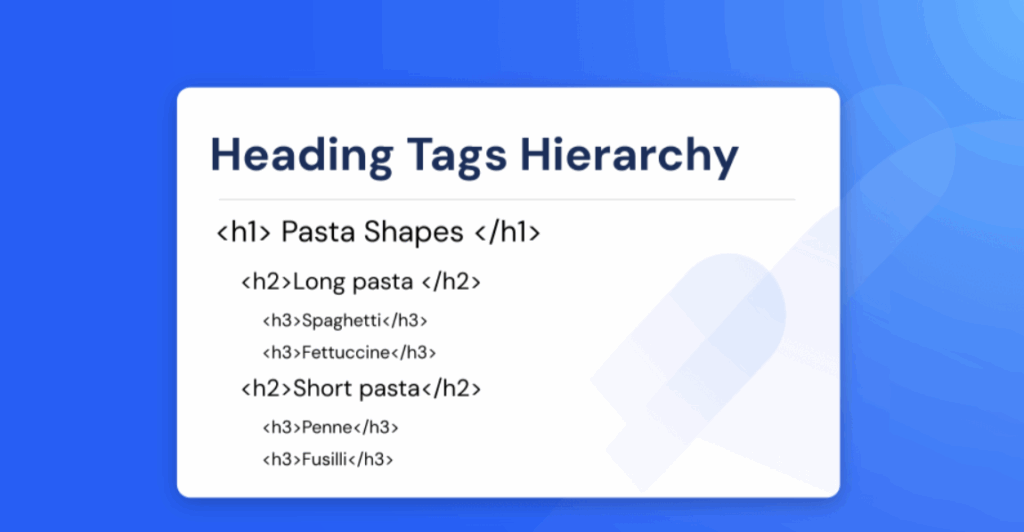
H1: How to Grow Indoor Plants
H2: Best Indoor Plant Types
H2: Light and Water Requirements
H2: Mistakes to Avoid
With the H1 being a heading subject, the H2s organize the content into logical sections.
Hence, one usually hears the question of why are h1 and h2 headings important for seo moz — because the right heading structure informs a search engine as to the hierarchy of your content and hence gives it a better chance of ranking.
Why H1 and H2 Heading Tags Are Important in SEO?
Now let’s understand why heading structure affects search ranking.
1. Readability for Marketing Content
User wants to read content at one glance. When h1, h2 tag headings are in the content, cluttered lackluster reading becomes difficult for the readers, and they will not scale through to get bored and go to the segment that spells the content for them. This keeps them interested.
2. Both, Search Engines Determine Intended Meaning from the Content
Search engines look at the overall structure of a page. Also, having a clear h1, h2 headings seo format allows Google to ascertain what each section deals with, hence linking your content to related search queries.
3. Increased Keyword Relevance
Keyword relevance in the heading works in your favor. You should, nonetheless, make sure they flow naturally. In effect, your proper structure actually aids your ranking instead of hurting it through keyword stuffing.
What Are H2 Headings and How Do They Effect Change?
H2, or heading 2, are the major sub-headings within your content. They divide your writing into sections clearly and digestibly so that the reader can take in the topic in one step at a time. They also betray the structure of your page to search engines and, in turn, the semantic organization of ideas.
H2 headings serve the following purposes:
Dividing your article into meaningful sections
The principle is that each H2 is assigned a certain segment or idea within the contents. In so doing, it provides an outlay or splash on which to move effortlessly from one section to another by the reader without any intervention of register in his mind asking questions of being confused or overwhelmed.
Clearly Introduce the Sub Topics
When one discusses a new point or view, an H2 heading is given to indicate that a new section has started. This aids in quicker scanning of information and also helps them in finding the very thing they are looking for in the page.
Help Readers Follow the Content Flow
People do not read every line; they skim through it instead. H2 headings are used as signposts that give the main outline of the article when someone just scrolls through a page.
Support Your Logical Thinking
An H2 heading must be correlated to the H1 main theme. Instead of drifting away from it or just for an arbitrary filling, each section should describe, prove, or elaborate upon it.
How Many Words Should H2 Headings Be?
Usually, a good H2 heading contains anywhere from 3 to 7 words. Just right, the length is descriptive, yet brief enough for the reader to quickly grasp wherein that section lies a certain concept. SEO wise, clarity counts, not complexity. Clean and straightforward H2 headings allow readers to scan your page with ease, while search engines can better understand the topic structure.
Here’s why:
- Clarity of the subtopic: Having an H2 heading forces one to remain short and concise, working solely on whatever main subject is represented by that section. Rather than embellishing in flowery language, the emphasis will be on that very key point that will be discussed in the content.
- It encourages better readability and scanning: Many of them scroll first; they could hardly be bothered to read every single line just to take the main idea of content, and having short and specific H2 actually helps them in this regard.
- It helps keep away from keyword stuffing and maintains a natural feel with the headings: Too many keywords make the heading act fake. Somewhere from 3 to 7 works just fine with a normal feel and still gives SEO points.
- It gives Google’s brain a window into the topical structure: Being a search engine, it uses headings to recognize how your content is organized within the document. Clear and concise H2s will mean that the layout makes sense, and it shall be easily relevant to the topic for Google.
- It aligns supporting points smoothly under each section: H2s that are too specific and short like their supporting ideas will smoothly align themselves with whatever falls under their umbrella; otherwise, one may discover their explanatory text oozing downhill out of point or populating that dull filler.
Why Shouldn’t H2 Headings Be Too Long?
When heading is too long, it will confuse people and give no impact at all. Readers may as well skip long headings because they don’t want to read something so complicated. Search engines, however, want clear and concise section labels.
Why Shouldn’t H2 Headings Be Too Short?
I cannot fully explain this concept. For example, suppose a heading reads “Tips.” It would not be clear what that is all about. “Tips for Saving Time While Writing” would be much clearer.
So the best answer to this question of how many words H2 headings should have is: short, meaningful, and descriptive.
How Many H2 Headings Should There Be on One Page?
This depends on the content length:
| Content Length | Suggested Number of H2 Headings |
|---|---|
| 800–1200 words | 3 to 6 H2 headings |
| 1500–2000 words | 6 to 10 H2 headings |
| 2000+ words | 8 to 12 H2 headings |
This is where the balance sample comes into place.
Having too few H2 headings makes the content look dense and wearying.
Having too many may end up working against breaking the content into fragments and obstructing the flow of reading.
How to Align Supporting Points With H2 Headings
Making supporting points align with H2 headings implies that the content written below a heading must clearly agree with the subject matter the heading offers. In other words, it matters that the structure is kept clearly so the reader would not get lost.
There should be a clean toss-up between H2 headings and supporting points:
- Each paragraph below an H2 should be about that heading : The heading is introducing the topic of the section. Everything else under it should serve to explain, support, or develop this topic and not divert to other ideas.
- Do not stray from the main subtopic : When there is a mixture of two unrelated topics in a section, content is harder to follow, whereas it should be easy to read while creating a neat structure.
- Keep each section focused and relevant : Each section might deal with a particular subject so the reader can understand the message with a step by step procedure. This will also save from having long sections filled with random content that feels disconnected.
Example:
H2: Benefits of Walking Every Day
This heading would include the particular features interested in heart health, mood, and weight control.
Well, one would not want that any time under this particular heading people begin to talk about running or diet tips-that would hamper the structure and breakdown reader comprehension.
Best Practices For SEO of H2 Headings
In other words, strategic use of H2 headline makes your content more easily searchable for readers and more colloquial for search engines. It’s actually about laying out some kind of street map for the reader and showing Google all the ways in which your main topic is explained, that’s one good use of H2 that could promote rankings, engagement, and clarity all at the same time.
Some of the Best Practices for SEO H2 Headings are:
Use Keywords Naturally
For example, an H2 heading with target keywords related to content writing tips, such as “content writing tools,” will absorb other SEO elements. However, the keyword should fall naturally on the heading and should never be forced upon it. Headings, which feel so to say genuine, aid in a smoother content flow and build credibility for the contents.
Each H2 Should Be Clear and Useful
The user should understand from the heading what the section is about. A clear subheading facilitates the right expectancy towards the content and keeps the user engaged. When readers comprehend exactly what they shall be taught about, they usually stay on and read throughout that section.
H3 Headings Should Be Used When Explanation Gets Detailed
Sometimes, a topic under one H2 needs more explanation. Using H3 headings here and there to break down the information into smaller bits helps keep these paragraphs from getting too lengthy and disorganized, creating an easy to follow structure instead.
Maintain an Undisturbed Logical Flow throughout the Article
Your headings should be so arranged as to make sense logically. Each H2 heading should correspond to the preceding one or introduce the next part of the topic in a smooth manner. Do not jump from unassociated points- it breaks the flow and can confuse readers.
Conclusion
There is no set amount of H2 headings that must be used. More important is the structure of content clearly. Use H2 headings when you move from one idea to another and want to guide the reader to the next part of the topic.
In general, there is a need for perhaps two to three H2s on a page that is short, while on a page that is longer, there is room for a few more H2s so that the reader doesn’t get lost or overwhelmed. The intention here is to shoot for clarity instead of counting how many headings one has.
Use the keywords in headings only when they fit naturally and meaningfully. Never swallow your pride and force keywords just for SEO. Headings should assist both thinking and search engines in grasping what your page is about.
If your structure is well formed, your content will be easy to read. Easy to read content naturally yields good SEO.
FAQs
What Use Do H2 Headings Have In Content?
H2 headings divide content into different sections. They guide the reader from one idea to another and ease scanning of the content. They however also allow search engines to figure out the topic’s structure.
How Many H2 Headings Should I Use On a Page?
There are no fixed numbers. The short pages may only include two to three H2 headings. The longer the pages, the more H2 headings can be included. The important thing is that each H2 represents an actual section worthy of having an H2 and is not there just to pad the count.
How Long Should H2 Headings Be?
From 3 to 7 words: the best length. Short enough to be clear and readable but not so short as to sound forced or too weighty. Therefore, keep your headings brief for easy reading.
Should keywords be inserted into H2s?
A heading is probably okay if the keyword fits smoothly in a heading and helps to clarify the topic; otherwise, forced keyword usage decreases readability and user experience.
Does the keyword stuffing of H2 headings hurt your SEO?
Too many H2s alone are not a problem, but the content is anyway made true random or untrue headings could use-luck. Use H2 headings for a reason, and do not add them where they are not needed.
Does the style of the H2 heading have an impact on the user experience?
These header tags give the users an option to quickly skim through the content to arrive at the information of interest. A clearer structure would hold the readers on the page for a longer time, so in an indirect way, it would lend a hand in SEO.